

IHK Ostbrandenburg, Viadrina and Western IHK Gorzów warn of long-term damage caused by ongoing border controls and call for rapid relief measures.
Representatives from business and science report that the controls at the German-Polish border are hampering the mobility of workers and researchers, disrupting supply chains and making cross-border cooperation and education much more difficult. The border controls introduced by the German government two years ago and the measures taken by the Polish government from summer 2025 are thus increasingly affecting everyday life in the Germany-Poland border region. This development particularly affects the areas of eastern Brandenburg and western Poland. This is the conclusion of the "Neighborhood as an Economic Engine" conference, which brought together German and Polish stakeholders at the Collegium Polonicum in Słubice on 27 November.
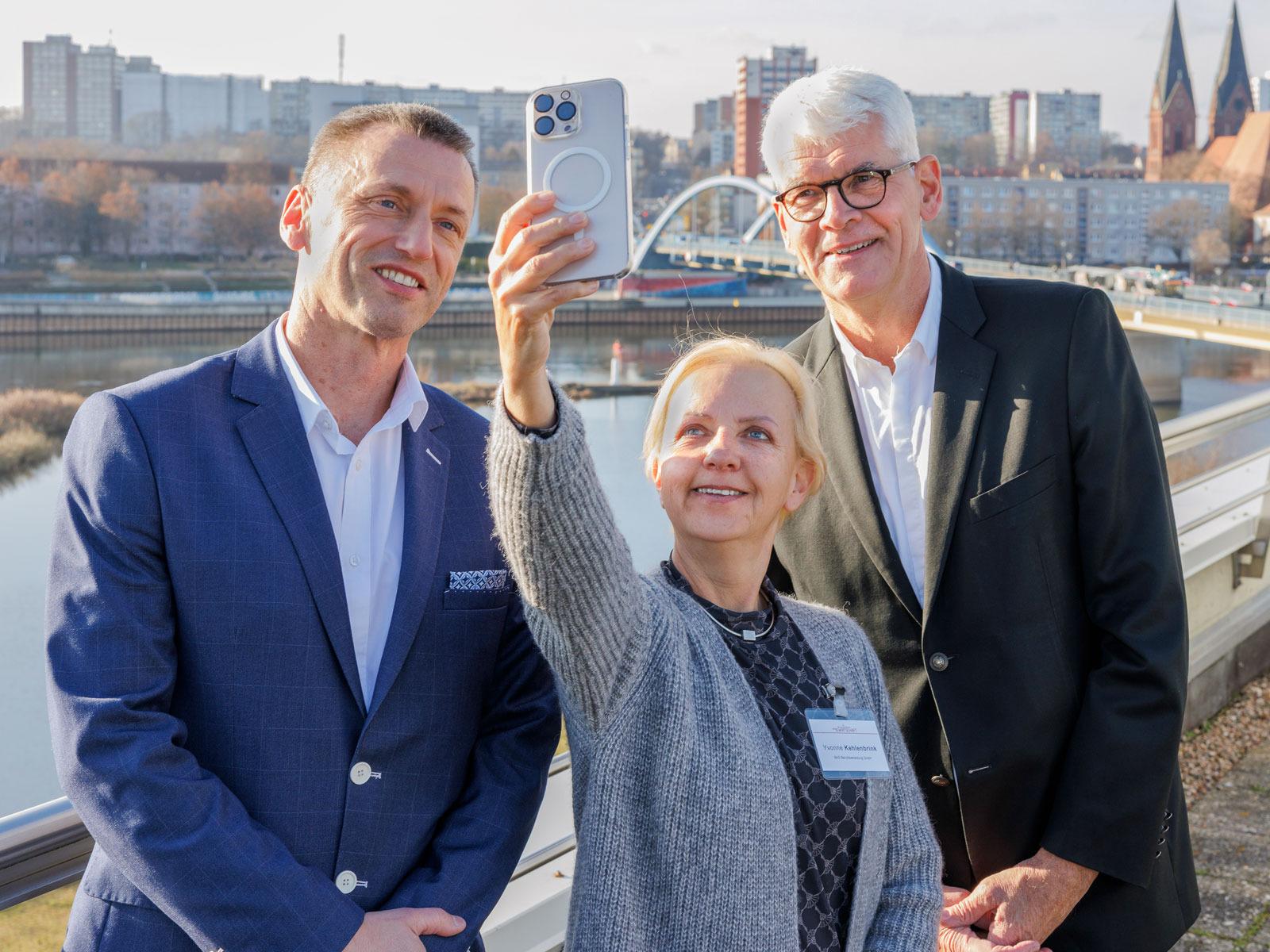
"Permanent border controls threaten the successes that we have built up in cross-border cooperation over the last 30 years. We need an exit strategy", warns Yvonne Kehlenbrink, Vice President of the East Brandenburg Chamber of Industry and Commerce. "Incalculable work routes, disrupted production and supply chains lead to noticeable disadvantages for companies and society on both sides of the border. Our region needs a permanent, close network across the Oder."
"Viadrina sees itself as a cross-border European university that maintains a German-Polish campus in Frankfurt (Oder) and Słubice. The current stationary border controls affect our day-to-day work and, with their far-reaching media perception, damage our self-image and reputation as an open, international university," emphasizes Prof. Dr. Eduard Mühle, President of the European University Viadrina.
"Economic cooperation in the German-Polish border region is of strategic importance for Polish companies. It is precisely here, at the interface of two markets, that thousands of companies are developing, benefiting from the proximity to partners, joint investments and the free movement of goods, services and labor. Thanks to the abolition of border controls and the integration of transport infrastructure, the border region has become an area of intensive trade, dynamic logistics development and growing employment," explains Andrzej Cegielnik, Vice President of the Western Chamber of Commerce in Gorzów. "The most important wish of Polish entrepreneurs today is to ensure smooth border traffic and further investment in the infrastructure connecting the two countries – especially in new bridges, road and rail connections. This is the only way to maintain the region's competitiveness and jointly build a strong, integrated European economy."
Business and science are therefore calling on the governments of both countries to take short-term measures to ease the burden. These include the establishment of two control lanes or a fast lane on the freeways as well as joint, random checks by the federal police and Polish border guards. In the long term, the German-Polish players are calling for a pan-European solution to migration policy and the restoration of complete freedom of movement within the EU.
Border controls contradict the European idea of a free market and significantly impair the benefits of the Schengen Agreement. "We must not allow unresolved migration policy issues to be carried out on the backs of the border regions," concluded Yvonne Kehlenbrink.
The "Neighbourhood as an Economic Engine" conference was organized by the IHK Ostbrandenburg as part of the East Brandenburg alliance "Pro Wirtschaft" together with the European University Viadrina and the Western Chamber of Industry and Commerce Gorzów (ZIPH) in cooperation with the European University Alliance ERUA.