

St Nicholas’ Church in Leipzig, as Johann Sebastian Bach would have seen it during his time as cantor in the 1720s, can now be experienced once again through a virtual reconstruction. This computer-simulated journey through time has been made possible by an interdisciplinary project led by Bach scholar Prof. Dr Alexander Grychtolik (Franz Liszt University of Music, Weimar), Prof. Dr Paul Zalewski, Professor of Heritage Studies at the European University Viadrina in Frankfurt (Oder), and the visualisation company Arte4D.
Together, they have virtually reconstructed the interior of St Nicholas’ Church as it appeared during Bach’s early years in Leipzig. In contrast to the church’s present-day appearance, with its striking, palm-shaped columns, the interior in Bach’s time presented a historically evolved, almost kaleidoscopic picture shaped by various architectural eras. Its condition at that time is documented by surviving illustrations, architectural plans and descriptions. The current appearance of the church interior, known above all as the setting for the ‘Peaceful Revolution’ of 1989, dates back to the Neoclassical renovation carried out between 1784 and 1797 by the city architect Johann Carl Friedrich Dauthe.
Reconstructed views of St Nicholas’ Church
Attempt at reconstruction of Leipzig’s St Nicholas’ Church by Alexander Grychtolik, Tobias Knobelsdorf and Paul Zalewski, visualisation: Andreas Hummel (Arte4D), 2026 (from left to right)
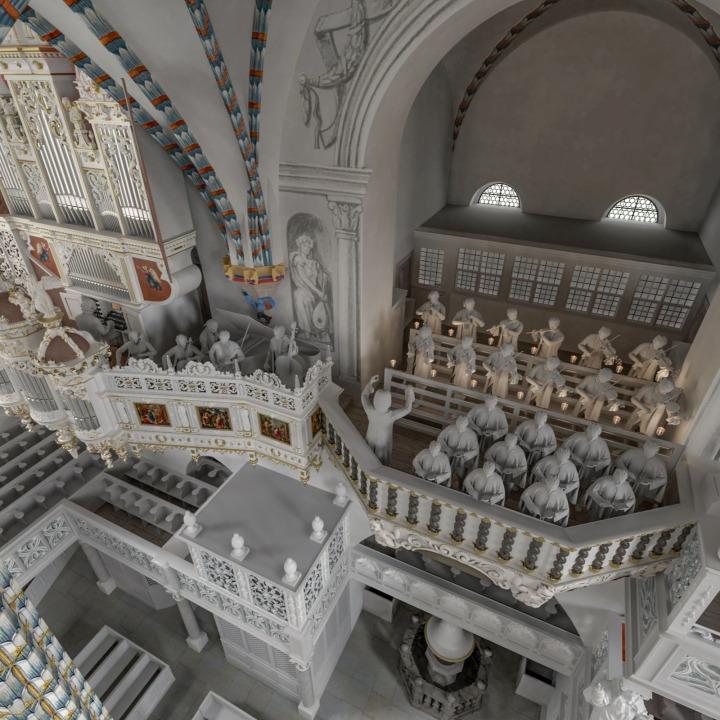
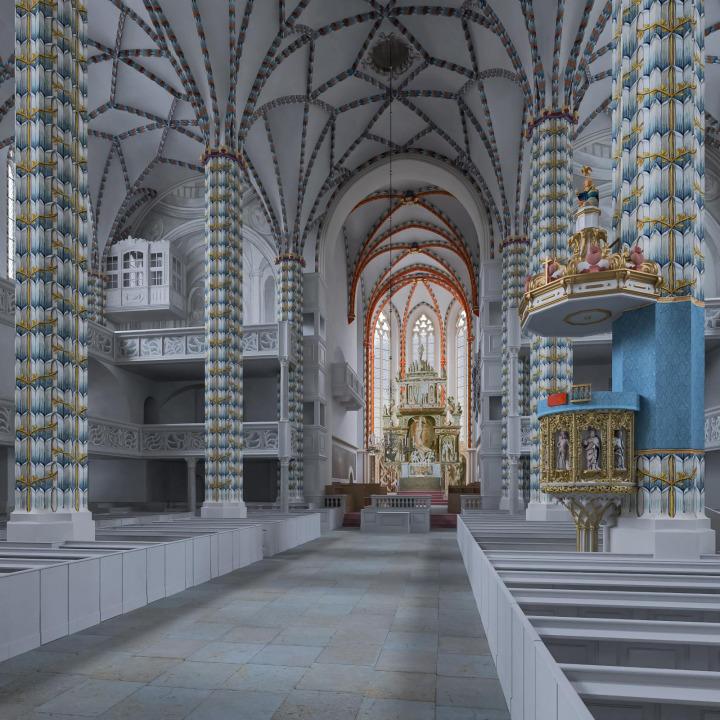
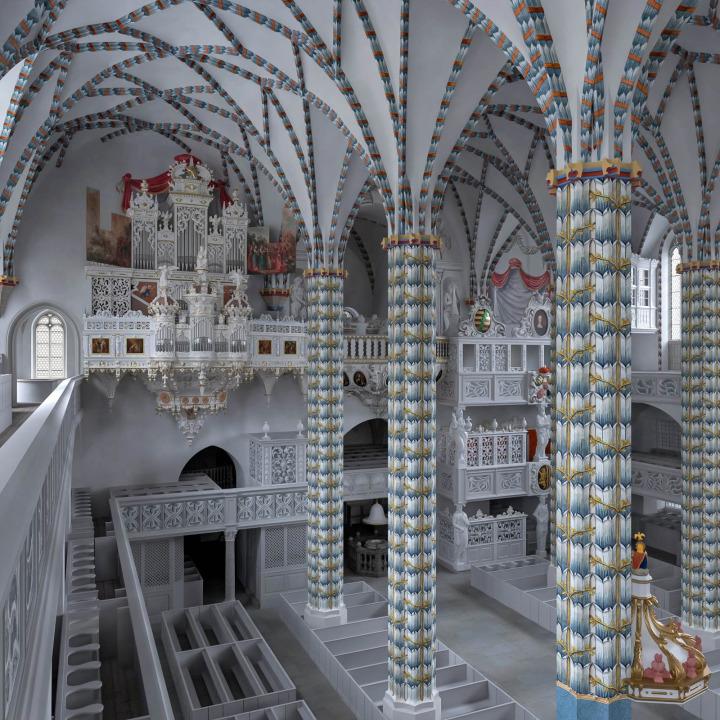
“With this virtual reconstruction, we can, for the first time, gain a fundamental understanding of the actual performance conditions under which Bach worked – that is, both the spatial arrangements on the musicians’ and organ galleries and the acoustic conditions,” explains the conductor and Bach scholar Alexander Grychtolik, who initiated the project. Paul Zalewski emphasises: “When generating the complex 3D models to visualise numerous details, we were able to save half the time by using artificial intelligence. However, in such projects that break new scientific ground, humans continue to play the leading role.”
The visualisations, which were produced by the Dresden-based company Arte4D in collaboration with the architectural historian Dr Tobias Knobelsdorf, are to be used for teaching purposes in the Master’s programme in the Protection of European Cultural Heritage at Viadrina University to convey the history of church architecture. There are also plans to present them at Bach concerts, so as to allow the audience to virtually step into the shoes of churchgoers from that era.
The project was funded by the Sutor Foundation (Hamburg) and the Aventis Foundation (Frankfurt am Main).
Project participants
Prof. Dr Paul Zalewski studied art history and heritage conservation at Nicolaus Copernicus University in Toruń (Poland) before coming to the University of Bamberg to undertake postgraduate studies in heritage conservation. In 2000, he was awarded his doctorate at the Department of Architecture at the Technical University of Berlin and subsequently worked as a research assistant at the Chair of Historic Building Conservation at the Bauhaus University Weimar. Following a junior professorship in building research and heritage conservation at Leibniz University Hannover, he joined the European University Viadrina, where he has held the Chair of Heritage Studies since 2009 and heads the Master’s programme in the Protection of European Cultural Heritage.
www.kuwi.europa-uni.de/de/professuren-mitarbeitende/denkmalkunde/index.html
Prof. Dr Dr Alexander Grychtolik studied architecture at the Bauhaus University in Weimar and music at the ‘Franz Liszt’ University of Music in Weimar and at the Royal Conservatoire in Brussels. He obtained his doctorate in 2010 in the field of heritage theory at the Bauhaus University in Weimar and in 2022 in musicology at the Hamburg University of Music and Theatre. Since 2021, he has been an honorary professor at the Franz Liszt University of Music in Weimar and, since 2024, a visiting researcher at Sacred Heart University in Tokyo. Alongside his international concert career as a harpsichordist and conductor, he conducts musicological research on Bach and historical concert halls, and specialises in historical improvisation.
www.grychtolik.com
Arte4D has specialised for more than 20 years in the visualisation of historical architecture to illustrate history in publications, exhibitions and on websites. The work is based not only on building plans but also on the analysis of historical inventories and other sources – including the firm’s own archival research – and the interpretation of these materials. The company’s owner, Andreas Hummel, trained as a carpenter and cabinetmaker at VEB Denkmalpflege Dresden and studied architecture at TU Dresden. Over many years, he has focused on the reconstruction of medieval fortifications and Baroque urban spaces, working closely with historians and architects.
https://arte4d.de/start.html

Background: St Nicholas’ Church and Bach
Leipzig’s St Nicholas’ Church is not only an outstanding architectural monument and a site of democratic history, but also holds a prominent place in the history of music as the former place of work of Johann Sebastian Bach from 1723 to 1750. It was here that Bach first performed his St John Passion, the Christmas Oratorio and many of the cantatas he composed whilst in Leipzig.