

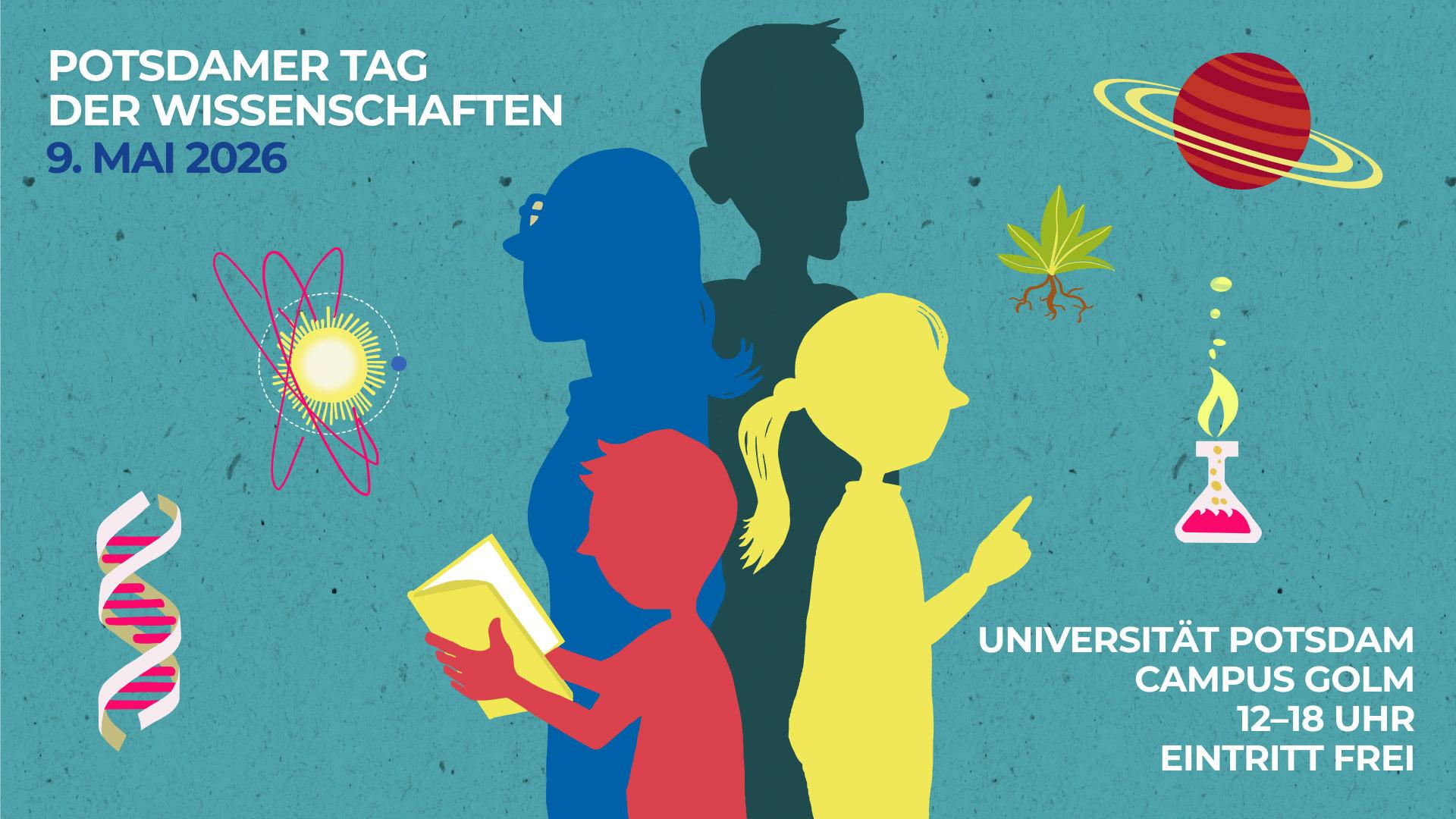
"Research. Discover. Join in." – is the motto of the Day of Science in the state capital on Saturday, 9 May 2026, from 12 p.m. to 6 p.m. The Brandenburg University of Technology Cottbus-Senftenberg (BTU) is helping to organise this event with an exciting and informative programme. The European University Viadrina Frankfurt (Oder) and the Technical University of Applied Sciences Wildau will be taking part on the Golm campus of the University of Potsdam with hands-on experiments and lectures.
More than 40 universities, schools and research institutions in Brandenburg will be presenting their day-to-day work beyond the walls of their institutes with a variety of programme items on the 13th Potsdam Science Day. Admission to this event for the whole family is free.
Brandenburg University of Technology
Cottbus - Senftenberg (BTU)

Professors, staff and students of the BTU will present a diverse programme of lectures on current research topics on the Golm campus of the University of Potsdam. At the same time, the numerous guests of all ages can look forward to hands-on experiments and activities at the BTU information stands – all in the centrally located Building 27.
In addition, BTU Cottbus-Senftenberg will be present at the Potsdam Science Day as part of the Walk of Facts – a joint poster exhibition of Brandenburg's science landscape. Low-threshold, easy, catchy and easy to grasp at first glance, positive facts from science are conveyed and something is set against fake news.
All-day activities in the BTU programme
At the stand of the Centre for Scientific Continuing Education with various stations in the foyer, the focus is on strategies under the direction of Heike Bartholomäus. Under the heading "Don't panic. Plan B. – Learning for the unknown", interested visitors can find out how best to react to the unexpected. Modern robot technology can be experienced in a playful way with the Unex school laboratory at the university's college under the direction of Dr Olaf Gutschker. Small robot arms can be operated using controllers or even gesture control. You can also find out about the BTU's modern study programmes.
Lectures provide insights into current research
The exciting lecture programme from the BTU can be experienced between 2 p.m. and 6 p.m. in lecture hall 1.01 of building 27. Scientific topics will be presented by the speakers in a generally understandable way and most of them are also suitable for children aged ten and over.
- Together with Prof. Dr Lin Xie, the humanoid robot Ami will explore the question of whether a robot can provide advice and help with decisions. Visitors will have the opportunity to talk to Ami.
- Dr Steffen Braune from the Institute of Biotechnology will be demonstrating how the cyanobacterium spirulina can help us stay healthy and combat climate change. Among other things, he will report on research into the influence of spirulina ingredients on cancer cells.
- How will we fly in the future – more quietly, with lower emissions, more efficiently? The lecture by Prof. Dr Lars Enghardt in cooperation with the German Aerospace Centre (DLR) provides exciting insights into aviation propulsion research of yesterday, today and tomorrow – from the first propellers to ultra-modern electric propulsion systems.
- "Why World Heritage?" asks Prof. Dr Johanna Blokker and highlights the benefits and disadvantages for society in her presentation. UNESCO created the concept to promote peace and sustainability. However, this noble vision often falls short of its promises. She discusses why we should continue to pursue the dream.
- Our world is changing rapidly. But some people and organisations remain capable of acting even in exceptional situations. Bartosz Łysakowski and Henry Herkula from the Centre for Scientific Continuing Education show why the ability to learn is becoming a key competence and how we can develop Plan B together, following the example of the open source community.
- Social care robotics in counselling older people is the subject of the presentation by health scientist Jörg Matthäi. Based on a pilot study, the opportunities and limitations of social care robotics for counselling, prevention and support in care practice will be discussed and implications for the future design of human-robot interaction will be highlighted.
Exhibition Walk of Facts
In addition, BTU Cottbus-Senftenberg will be present at the Potsdam Science Day as part of Walk of Facts – a joint poster exhibition of Brandenburg's scientific landscape. Low-threshold, easy, catchy and easy to grasp at first glance, positive facts from science are transported and something is set against the fake news. 29 institutions are participating in the Walk of Facts exhibition, and the BTU is present here with content from the fields of ecology, Lichtenberg Professorship Neuroadaptive Human-Technology Interaction, singing / singing didactics and energy economics.
European University Viadrina Frankfurt (Oder)
A varied programme with workshops, experiments and multimedia presentations, including on smartphone use in families and the recognition of AI content, awaits visitors to the research camp from 12 p.m. to 6 p.m. Viadrina researchers will also be giving talks on life on the former inner-German border and German-Ukrainian town twinning.
The Viadrina is represented with an interactive programme at the research camp as well as two lectures. In addition, student ambassadors will provide insights into studying at the Viadrina from 12 p.m. to 6 p.m.
Viadrina programme at the research camp
Stand 27 (between House 29 and House 32)
- 12.00 p.m. | Prof. Dr Lauri Wessel and Merle Pohl
"Now put away your mobile phone" – Improving the use of smartphones in everyday family life (hands-on experiment) - 1.30 p.m. | Prof. Dr Miriam Lind, Marlén Jacobshagen, Hannah Sawall
"Talking at the touch of a button – human-animal interaction and communication technology" (hands-on experiment) - 3.00 p.m. | Prof. Dr Sascha Münnich
"Are video games becoming more and more like the real world or is the world becoming more and more like a video game?" (Multimedia presentation) - 4.30 p.m. | Prof. Dr Charlotte Köhler
"Understanding artificial intelligence: How AI learns and how to recognise AI content" (hands-on experiment / workshop)
Viadrina lectures in House 14
Learning room 0.47
- 2.00 p.m. | PD Dr Carolin Leutloff-Grandits
"A still divided sky? Interdependencies along the former inner-German border" (lecture with discussion) - 3.00 p.m. | Dr Susann Worschech
"German-Ukrainian town twinning: Can municipal foreign policy contribute to peace in Europe?" (lecture)
Technische Hochschule Wildau (TH Wildau)
Wildau University of Applied Sciences (TH Wildau) will once again be represented at this year's Science Day with an information stand, current research topics, new degree programmes and hands-on activities.
Become a materials researcher
Discover the world of materials research: In the hands-on experiment, the team led by Prof. Christian Dreyer shows how fibre-reinforced plastics can be produced. It demonstrates how plastics are reinforced: Plastic granulate is heated and mixed with various natural fibres. The result is a fibre-reinforced material that those keen to experiment can design themselves and take away with them. At the same time, they will learn how two different materials are combined to create a stronger material and what natural fibres do in modern composite materials – a playful research experiment for young and old alike.
From robot safety to the city of the future
The TH Wildau is known for its strong focus on applied research. At stand 34 in the research camp, current research at the university will be live and hands-on: How does a robot help to make take-offs and landings at the airport safer? How can nutritious and healthy food be produced in the city of the future? How can we work together to create a future worth living in for the world of tomorrow? There will also be the opportunity to talk to the scientists behind the ideas.
Studying what moves Brandenburg: New degree programmes for the mobility of tomorrow
Mobility means getting people and goods from A to B. It shapes our everyday lives – on the road, in the air and in the city. It characterises our everyday lives – on the way to work, to school or when shopping. For mobility to continue to function well in the future, it must be safe, environmentally friendly and well connected. This is what researchers at TH Wildau are working on in the Sustainable Mobility focus area: they are combining new technologies, smart planning and digital solutions to make transport and logistics simpler, more efficient and more sustainable.
And they are training the specialists of the future who will be needed for this. With the new Bachelor's degree programme Mobility, Environment, Logistics (MUL) and the dual Bachelor's degree programme Mobility and Administration (MoVe), TH Wildau is therefore starting the coming winter semester with two new courses. These and many other degree programmes at the university will be presented at the stand. "Meet the Prof": Professors and the student orientation team will explain how academic education at TH Wildau works, what prospective students can expect on campus and what prospects are open to them.
DIY in the ViNN:Lab – creativity meets technology
Welcome to the ViNN:Lab, the makerspace at TH Wildau! Here, ideas can become real small or even large projects. The ViNN:Lab makes it possible to try things out, tinker and create. The stand will provide information on the wide range of offers and the opportunity to get active yourself: Choose a motif and apply it to a baseball cap using a textile press. Younger visitors in particular will have fun learning how textile printing works and how ideas can be turned into real products. Modern tools and creative materials are available and, of course, you can also take your unique piece home with you.
All free offers are available at stand 34 in the research camp.

When and where?
13th Potsdam Science Day
Saturday, May 9, 2026 | 12:00 p.m. to 6:00 p.m.
Universität Potsdam, Campus Golm
Karl-Liebknecht-Straße 24-25, 14476 Potsdam
On the event website www.ptdw.de, interested visitors can find, among other things, the diverse program and an overview of the participating institutions.